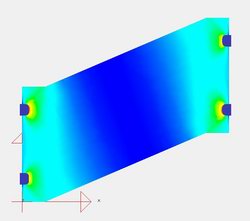
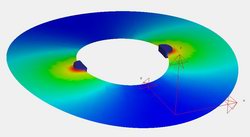
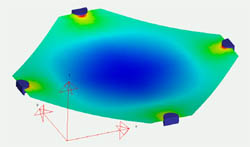
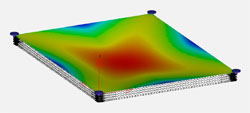
The dimensioning and stress calculation of plate structures under various loads is a standard task of the daily engineering practice. Panes varying from a rectangular form can no more be calculated by table works or manual formula but have to be evaluated by the method of the finite elements.
In the glass building sector the systems to be examined are often very similar. But if boundary conditions, fixings or the thickness must be changed every time new meshes must be created. For the calculation of laminated safety glass generally there was need to work with volume elements.
The bearing conditions are often special variants like elastic rubber supports, point fixings or edge clampings, which take a long time to generate. The evaluation of the calculation results then always follows the same method (deformations, stresses, proof) and so far must be read out explicitly of the finite element data in an expensive way.
Additionally, there is hardly a possibility to calculate insulating glass units (from 2, 3 or 4 laminated glass panes) if any pane shape shall be examined or geometrically non-linear approaches shall be used.
This is where the program SJ MEPLA applies:
All inputs, like the geometry, the bearing conditions, the kind of loads, the calculation approach or the requested output, are guided and displayed by input masks. The control and output of the results occurs visually on a graphics surface and a calculation protocol, which can be added to the static assessment.
Special new finite element methods allow the simple input and quick calculation of sandwich structures (laminated safety glass), so that the entire problem can be solved at shortest time (within a few minutes).
Thus the program is suited for dimensioning as well as for static calculations, for which it offers a variety of calculation possibilities:
- automated mesh generation for straight or curved borders by the input of corner points. The element size is preset, but may also be changed manually to increase the accuracy of the calculation. (The user, however, is not aware of the fact that he is working with a Finite Element Program)
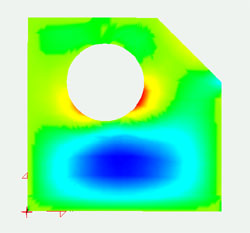
- with this, any system shape including cut-offs or holes are possible
- all subsequent calculations can be made linear or geometrically non-linear (large deformations).
- any pane structure (e. g. of laminated safety glass) considering the stiffness of the compound material by input of the layer order
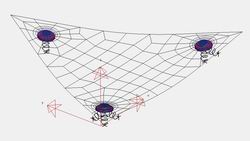
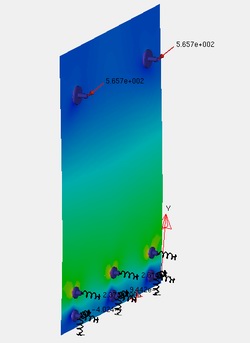
- consideration of pre-defined bearing designs for the plate edges as well as for any point bearing with the corresponding spring rigidities
- fully automated installation of point fixings
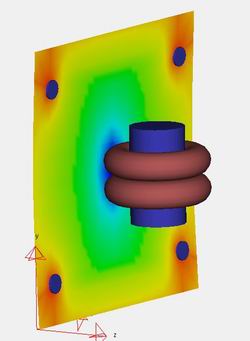
- countersunk or disk fixings (own elements) with the stiffness of the circular plate layer and the bush by means of elasticity-module and thickness specifications
- balustrade clips with circular or angular shape (usable as glass shoes)
- downholders with circular or angular shape
- bonded fixing without generation of holes
- point fixings with covering glass panels
- specification of the bearing stiffness (sub-construction or type of the point fixings)
- optional use of springs or tie bars at the point fixing
- the properties of the point fixings can be stored in a database
- point supported insulating glass units
- spacers in insulation glass (e.g. unsupported borders)
- elastic edge or line supports including contact conditions
- elastic beams acting at the borders
- elastic base calculations
- any positioning of local springs with translation and rotation degrees
- effect from temperature differences given for each layer
- face loads, line loads, water pressure
- dead weight (indication by the direction of the gravity vector)
- any point loads which are automatically distributed over the given area
- calculation of insulation glass under consideration of the gas pressure laws in the intermediate pane space (gap) under any load (climate loads like pressure differences, thermal expansion of the gas, external loads, pendulum impact,…)
- calculation of load cases with any combinations of loads and related safety factor
- automated load case generation and design proof according to any Codes (also DIN EN16612:2019, Ö-Norm, NEN2608, CAN CGSB 12.20, ...)
- free selectable safety and combination factors for Ultimate Limit State and Serviceability Limit State
- the formula can be written by the customer himself for actually not included norms (a formula interpreter allows any formula to consider)
- combination depth can be adjusted
- additional protocol with load case results and resistance check
- open protocol format to be used in any word processing program
- point fixings or the panes inside the insulation glass can be calculated with contact algorithms
- applying loads at fixings
- dynamical calculation of the pendulum impact for single-layer glass, laminated and insulation glass of any design
- the drop height of the pendulum and the impact point can be freely chosen
- enhanced Kelvin-Voigt impact model. This is an alternative to the pendulum body and allows also to model persons, animals or other impactors like footballs, hailstones, …
- linear or non-linear approaches for single glass layers, laminated safety glass and also for insulating glass units
- dynamically calculated pressure hits like wind blasts
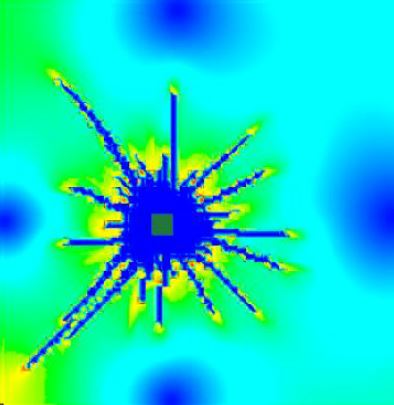
- qualitative simulation of the residual load-bearing capacity of the cracking behaviour or broken panes
- output of curve diagrams for forces, deformations and stresses during the impact period for any predefined position
- multi-language (German, English, French, Dutch, Italian, Spanish, Portuguese, Polish and Czech)
- multi-processor usage for very fast equation solving
- In-Core and Out-Of Core solver for largest systems
- manifold evaluation possibilities in the post-processor
- stresses across the plate thickness and layer order at any point
- display of the pendulum impact in slow-motion
- output of all stress components
- vector-plot of the principal stresses
- colored display of deformations